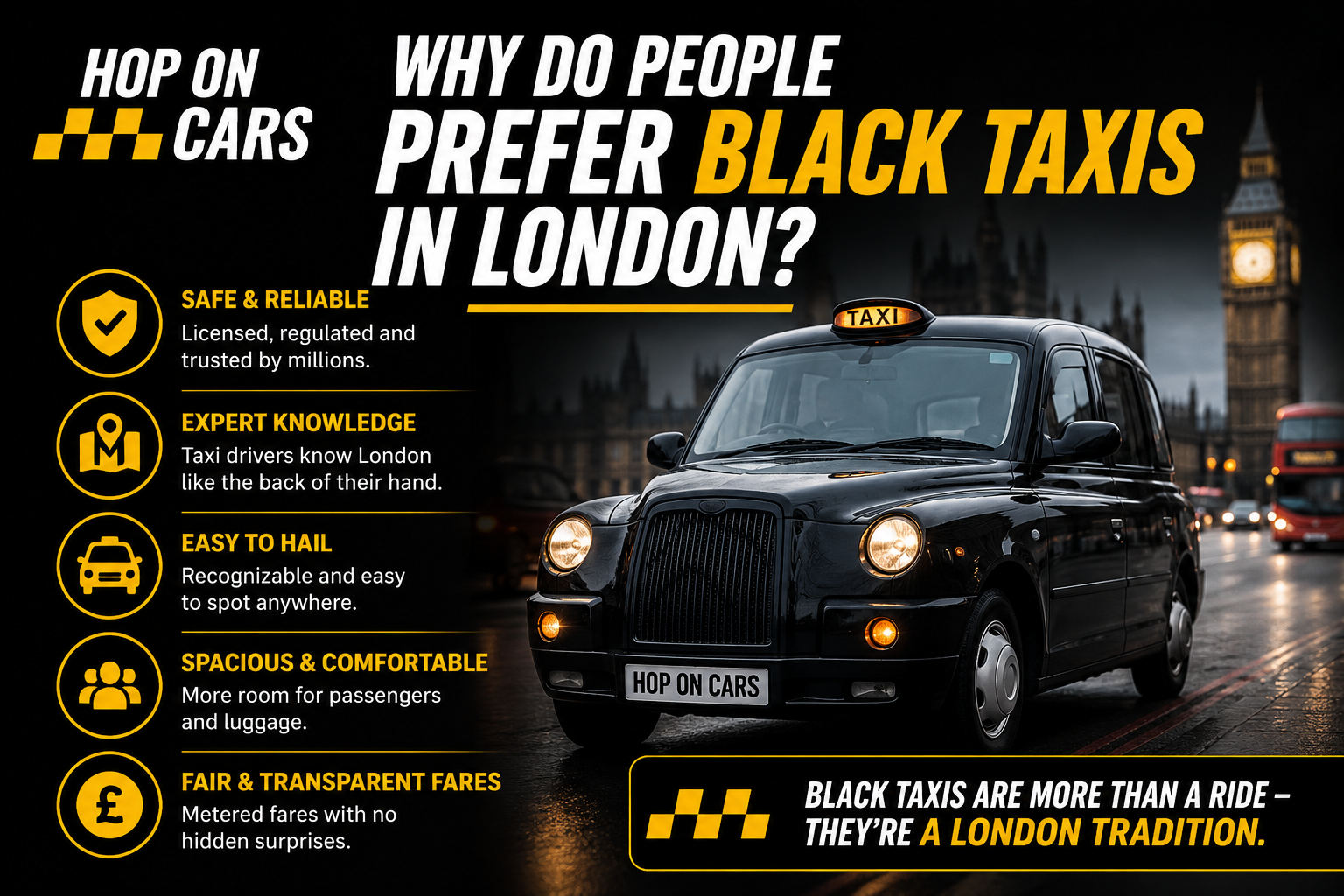
If you've ever stood on a London street corner and watched one of those distinctive, rounded black cabs glide past, you'll know there's something different about them. They're not just another way to get from A to B. For millions of tourists, business travellers and lifelong Londoners, the black taxi is as much a part of the city's identity as red buses or the Underground roundel.
But why do so many people still choose black taxis over minicabs, ride-hailing apps or private hire cars? The answer sits somewhere between practicality and trust. In this guide, we'll look at what a black taxi actually is, how London's black cab service works, and why it continues to hold such a strong place in the capital's transport landscape — alongside where a pre-booked service like Hopon Cars fits into the picture.
What Is a Black Taxi?
A black taxi is a licensed London Hackney Carriage that can be hailed on the street, picked up at a taxi rank, or booked in advance, and is legally permitted to carry passengers without a pre-arranged booking.
This is the key legal distinction. Unlike minicabs or private hire vehicles, a black cab doesn't need to be booked ahead of time. Its driver has passed a demanding geographical exam known as The Knowledge, and the vehicle itself must meet strict Transport for London (TfL) standards covering turning circle, wheelchair access, and passenger safety. Despite the name, not every black cab is actually black any more — many now carry advertising wraps in every colour imaginable — but "black taxi" and "black cab" remain the terms most people use for this class of licensed London taxi.
History of London's Black Cabs
The story of the black cab stretches back further than most people realise. Licensed horse-drawn carriages for hire were regulated in London as early as 1654, and the term "Hackney Carriage" — still used in law today — comes from this era. The Hackney Carriage Act of 1831 (with further regulation in 1834) formalised licensing requirements, setting the foundation for the taxi trade we recognise now.
Motorised cabs arrived in the early 1900s, but it was the Austin FX3, launched after the Second World War, that really established the shape people associate with a "London taxi" today. Its successor, the FX4, became the classic black cab silhouette from the 1950s through to the 1990s. Since then, the TX series and the newer LEVC TX — an electric black cab — have carried the tradition forward while modernising emissions standards and passenger comfort.
Why Are London Taxis Black?
London taxis were originally black largely for practical and commercial reasons, not because of any legal requirement.
When the Austin FX3 went into production, black paint was cheaper and more readily available, and it gave the fleet a smart, uniform appearance. Over time, "black cab" became shorthand for the whole vehicle class, even though there was never a strict rule demanding every taxi be black. Today, TfL permits liveries and advertising wraps, so you'll spot black cabs in blue, red, gold and every colour in between. The name has simply outlasted the paint job.
How Black Taxis Work
Black taxis operate under a licensing system run by Transport for London. Drivers and vehicles are licensed separately, and both must meet ongoing standards. A black cab can be:
- Hailed directly from the street
- Picked up from a designated taxi rank
- Booked in advance through a taxi app or by phone
Fares are calculated using a TfL-regulated meter, which takes into account distance, time and applicable tariffs. This regulated, metered structure is one of the main reasons passengers feel confident stepping into a black cab without agreeing a price beforehand.
The Knowledge Taxi Test Explained
The Knowledge is the training and examination process that London black cab drivers must complete before they can be licensed, and it's widely regarded as one of the toughest tests of its kind in the world.
Trainees are expected to memorise thousands of streets and points of interest within a six-mile radius of Charing Cross, along with the most direct routes between them. Preparation typically takes between two and four years, involving countless hours spent riding mopeds around the city with route sheets, followed by a series of oral examinations at TfL. Many candidates don't pass on their first attempt. The result is a driver who can navigate London's famously irregular street layout without relying on satellite navigation genuine, hard-earned local expertise that few transport systems anywhere can match.
Why London Black Taxi Drivers Are Highly Respected
That level of training has earned black cab drivers a strong professional reputation. Passengers often trust them to take sensible routes, avoid unnecessary detours, and handle unfamiliar addresses with confidence. Because licensing is tightly controlled by TfL, drivers are also subject to background checks and vehicle inspections, which adds another layer of reassurance, particularly for solo travellers, elderly passengers, or anyone new to the city.
Why People Prefer Black Taxis
There isn't one single reason black cabs remain popular it's a combination of trust, convenience and familiarity. Common reasons passengers give include:
- No need to pre-book; you can simply hail one on the street
- Confidence in the regulated metered fare system
- Knowledge that drivers are highly trained and licensed
- Comfortable, spacious cabin designed for passengers, not just drivers
- A sense of tradition and reliability tied to London itself
Benefits of Black Taxis
Beyond the emotional appeal, there are practical advantages too. Black cabs are built with passenger safety in mind, including a wide door and turning circle that makes them genuinely useful for anyone travelling with luggage, children, or mobility needs. Drivers are personally accountable to TfL, which means complaints and safety concerns are formally tracked. And because the fare is metered rather than negotiated, there's rarely any ambiguity about what you'll pay for a straightforward journey within London.
Black Taxi vs Minicab
| Feature | Black Taxi | Minicab |
|---|---|---|
| Can be hailed on the street | Yes | No booking required |
| Fare structure | Regulated meter | Pre-agreed or app-based fare |
| Driver test | The Knowledge | Topographical/local test (less extensive) |
| Booking required | No | Yes |
| Typical use case | Spontaneous city journeys | Pre-planned trips, airport transfers |
A minicab is a private hire vehicle that must be booked in advance through a licensed operator — it cannot legally be hailed or picked up from a rank. This is exactly why services like airport transfers or long-distance city-to-city taxi journeys are usually handled by minicab operators: a fixed, pre-agreed fare suits a planned trip far better than a street hail.
Black Taxi vs Uber
Uber operates in London as a private hire operator, meaning its drivers and vehicles fall under the same private hire licensing category as minicabs, not the Hackney Carriage licence held by black cabs. The practical differences are similar to the minicab comparison: Uber requires a booking through the app, fares are typically calculated by the app's own algorithm (with surge pricing at busy times), and drivers complete a different, less extensive local knowledge assessment than The Knowledge. Black taxis, by contrast, offer street-hail availability and a transparent, regulated meter, which some passengers still prefer for shorter, unplanned journeys around central London.
Black Taxi vs Private Hire
"Private hire" is the umbrella legal term covering minicabs, executive cars, and app-based services like Uber. The core distinction from black taxis comes down to one thing: private hire vehicles must be pre-booked, while Hackney Carriages can be hailed or ranked. For journeys that are planned ahead of time — particularly longer trips like an airport transfer or a city-to-city taxi journey — private hire and minicab-style services often work out more cost-effective, since the fare is agreed upfront rather than accumulating on a meter through traffic.
Airport Transfers Using Black Taxis
Black taxis can technically take passengers to and from airports such as Heathrow, Gatwick, Stansted and Luton, but metered fares over these longer distances can add up quickly, especially in heavy traffic. This is where pre-booked airport transfer services genuinely shine. A fixed-price airport transfer removes the guesswork entirely — you know the cost before you set off, regardless of how busy the roads are.
This is one of the main reasons travellers increasingly turn to a reliable airport taxi provider like Hopon Cars for journeys to and from Heathrow Airport, Gatwick Airport, Stansted Airport, Luton Airport and London City Airport. Pre-booking also means the driver is expecting you, tracks flight times, and can adjust pickup for delays — something a street-hailed black cab simply isn't set up to do.
Business Travel Benefits
For business travellers, predictability matters. Turning up to a client meeting or catching a flight on time depends on transport that won't derail your schedule. Executive-style minicab and private hire services, including Hopon Cars' professional minicab options, are typically built around fixed pricing, pre-confirmed pickup times, and drivers who know to expect corporate passengers. Black taxis remain a solid choice for short hops between meetings in central London, but longer or scheduled business journeys tend to suit a pre-booked service better.
Tourist Benefits
Visitors to London often find black cabs reassuring precisely because they don't need to research fares or negotiate anything — the meter does that job. Drivers' familiarity with hotels, train stations and tourist landmarks (thanks to The Knowledge) also means less risk of getting lost or taken on a longer route than necessary. For longer excursions or transfers to and from accommodation outside central London, though, a pre-arranged fixed-price taxi service can offer better value and certainty.
Accessibility Features
All licensed black cabs in London are required to be wheelchair accessible, which isn't the case across every private hire fleet. This makes black taxis an important option for passengers with mobility needs, wheelchair users, and those travelling with prams or bulky luggage. The wide passenger doors, swivel seats in some models, and low-step entry were all built into the vehicle design specifically to meet TfL accessibility standards — a genuine strength of the black cab system.
Safety Standards
Because Hackney Carriage licensing is tightly regulated, black cab drivers undergo background checks, and vehicles are subject to regular inspections to remain roadworthy. Passengers also benefit from full public liability insurance built into the fare. These regulatory layers are a big part of why black taxis are trusted by first-time visitors and locals alike, even late at night or in unfamiliar parts of the city.
Payment Methods
Modern black cabs are required to accept contactless and card payments, in addition to cash, following TfL regulations introduced to modernise the trade. This brought black taxis in line with the convenience that app-based services already offered, removing one of the older complaints passengers used to have about needing cash on hand.
24-Hour Availability
Black taxis operate around the clock, with a steady presence at major taxi ranks, train stations, and hotel forecourts throughout the night. This makes them a dependable option for late arrivals, early flights, or anyone needing transport outside of typical daytime hours, without having to rely on an app having available drivers nearby.
How Taxi Fares Are Calculated
London black cab fares are calculated using a TfL-regulated taxi meter, which factors in distance travelled and time taken, with different tariff bands applying depending on the time of day and day of the week. This regulated structure is designed to protect passengers from being overcharged, since the fare builds transparently as the journey progresses rather than being estimated upfront. For journeys where cost certainty matters more — such as a long airport transfer — a fixed-price, pre-booked fare from a minicab service is often the more predictable option.
How to Book a Black Taxi
There are three main ways to use a black taxi in London:
- Hail one on the street — simply raise your arm when you see an available cab with its light on.
- Use a taxi rank — found outside major train stations, hotels and busy areas across London.
- Book through an app — several licensed apps now allow you to book a black cab in advance, similar to a minicab.
For guaranteed pickup times, particularly for early journeys or longer trips, pre-booking either through an app or a dedicated taxi service tends to be more reliable than hoping to hail one nearby.
When a Minicab May Be a Better Choice
Black taxis excel at short, spontaneous journeys within central London. But for longer trips, city-to-city taxi journeys, or airport transfers, a pre-booked minicab often makes more financial and practical sense. Fixed pricing, advance scheduling, and door-to-door service from your exact location — rather than the nearest taxi rank — are all advantages that a service like Hopon Cars can offer, especially for families, business travellers, or anyone carrying heavy luggage.
How Hopon Cars Provides an Alternative
Hopon Cars offers a pre-booked, fixed-price alternative to the traditional black cab, built specifically around the journeys where advance planning matters most: airport transfers, long-distance city-to-city travel, and executive business trips. Rather than watching a meter tick over in traffic, passengers know their fare before they travel, with drivers tracking flight arrivals for airport pickups and confirming pickup times in advance. It's not a replacement for the black cab's street-hail convenience — it's a complementary option for the journeys where certainty and pre-arranged pricing matter more than spontaneity.
Conclusion
So, why do people prefer black taxis in London? Mostly, it comes down to trust — trust in a rigorously trained driver, trust in a regulated fare system, and trust built over more than a century of history on London's streets. Black cabs remain unmatched for short, unplanned journeys across the capital. But for longer trips, airport transfers, or anywhere a fixed price and pre-arranged pickup matter more, a service like Hopon Cars offers a practical, reliable alternative that complements rather than competes with London's iconic black taxi trade.
FAQs
1. What is a black taxi in the UK? A black taxi, also called a black cab or Hackney Carriage, is a licensed London taxi that can be hailed on the street, picked up at a rank, or booked in advance. Drivers must pass The Knowledge, an extensive geographical exam, and vehicles must meet strict Transport for London standards, including wheelchair accessibility. The name comes from the traditionally black paintwork of early models, though modern cabs now appear in many colours due to advertising liveries. Black taxis remain a distinct legal category from minicabs and private hire vehicles, which cannot legally be hailed and must always be pre-booked through a licensed operator.
2. Why do people hire black taxis in London? People choose black taxis mainly for convenience and trust. There's no need to book ahead, fares are calculated by a regulated meter rather than negotiated, and drivers are extensively trained through The Knowledge, reducing the chance of getting lost or overcharged. Many passengers also value the spacious cabin and wheelchair accessibility built into every licensed vehicle. For short, unplanned journeys around central London — hopping between meetings, heading to dinner, or getting back from a night out — a black cab is often simply the fastest option available on the street.
3. Are black taxis expensive in London? Black taxi fares can feel higher than minicabs or ride-hailing apps, particularly for longer journeys or trips during heavy traffic, since the meter continues running based on time and distance. For short trips across central London, the fare is usually reasonable and predictable. However, for longer journeys such as airport transfers, a pre-booked, fixed-price service tends to work out more cost-effective, since you know the total cost in advance regardless of traffic conditions or route length.
4. Black taxi vs Uber in London what's the difference? Uber operates under a private hire licence in London, meaning it must always be pre-booked through the app and cannot be hailed on the street. Black taxis operate under a Hackney Carriage licence, allowing street hails and rank pickups. Fares also differ: black cabs use a regulated meter, while Uber fares are calculated through the app and can rise during high-demand periods. Driver training differs too, with black cab drivers completing The Knowledge, a far more extensive geographical qualification than Uber's local knowledge requirements.
5. Black taxi vs minicab UK which should I choose? It depends on the journey. Black taxis suit short, spontaneous trips where you want to hail a cab on the spot and pay a metered fare. Minicabs suit planned journeys, particularly airport transfers or longer city-to-city trips, where a fixed price agreed in advance offers more certainty. Minicabs must always be pre-booked through a licensed operator and cannot be hailed on the street, unlike black cabs.
6. What is the difference between a black cab and a minicab? The core difference is licensing and booking method. Black cabs hold a Hackney Carriage licence, allowing them to be hailed or picked up at ranks without any booking. Minicabs hold a private hire licence, which legally requires a booking made in advance through a licensed operator. Black cabs use a TfL-regulated meter, while minicab fares are typically agreed before the journey begins, which can make budgeting easier for planned trips like airport transfers.
7. Can you hail a black taxi in London? Yes. Black taxis are the only licensed taxi type in London that can be legally hailed directly on the street or picked up from a designated taxi rank without a prior booking. You'll know a cab is available when its yellow "TAXI" light is illuminated. Minicabs and other private hire vehicles, including Uber, cannot legally be hailed and must always be booked in advance, which is one of the clearest legal distinctions between the two vehicle categories in London.
8. How do black taxis work in the UK? Black taxis operate under licences issued and regulated by Transport for London. Both the driver and the vehicle must be separately licensed, with drivers completing The Knowledge before qualifying. Passengers can hail a cab, use a rank, or book through an approved app. Fares are calculated using a regulated taxi meter based on distance and time, with different tariffs applying depending on the time of day. This structure is designed to keep pricing transparent and consistent across the whole licensed fleet.
9. Are London black taxis worth it? For short, unplanned journeys across central London, black taxis are often worth the fare thanks to their convenience, accessibility and trained drivers. They're particularly useful late at night, when hailing one at a rank can be faster than waiting for an app-based pickup. For longer trips or airport transfers, though, a pre-booked fixed-price service can offer better value, since the total fare doesn't depend on traffic or the exact route taken.
10. How much does a black taxi cost in London? Black taxi fares are calculated by a TfL-regulated meter based on distance and time, with tariffs varying depending on the time of day and day of the week. This means the exact cost of any journey depends on traffic conditions and timing rather than a single fixed rate. For longer trips or airport transfers where cost certainty is important, a pre-booked, fixed-price service is generally easier to budget for in advance.
11. Who can use black taxis in the UK? Black taxis are available to anyone, including tourists, business travellers, families, commuters and residents. Because every licensed black cab must be wheelchair accessible, they're also a genuinely useful and inclusive option for passengers with mobility needs, prams, or bulky luggage. There's no membership, app account or advance booking required to use a black cab — you simply need to find one available at a rank or hail it on the street.
12. Why are London taxis black? London taxis became associated with the colour black largely for practical, cost-related reasons after the Austin FX3 was introduced following the Second World War, when black paint was cheaper and gave the fleet a uniform look. There was never a strict legal requirement for taxis to be black, and today many black cabs carry colourful advertising wraps. The name "black cab" has simply stuck as a familiar term for the licensed Hackney Carriage vehicle class, regardless of actual paint colour.
13. What is The Knowledge taxi test? The Knowledge is the training and examination process required to become a licensed London black cab driver. Trainees must memorise thousands of streets and points of interest within six miles of Charing Cross, along with efficient routes between them, and are tested through a series of oral examinations at Transport for London. The process typically takes two to four years to complete. It's considered one of the most demanding taxi licensing exams in the world and is a major reason black cab drivers are so trusted for local navigation.
14. Do black taxis accept card payments? Yes. Following Transport for London regulations, all licensed black cabs are required to accept contactless and card payments in addition to cash. This modernisation brought black taxis in line with the payment convenience already offered by minicab and ride-hailing apps, removing the need for passengers to carry cash for every journey.
15. Are black taxis available 24 hours? Yes, black taxis operate around the clock, with steady availability at major taxi ranks, train stations, and hotel forecourts throughout the night and early morning. This makes them a reliable option for late-night journeys or early airport departures, particularly in central London where rank availability tends to remain consistent even outside of peak daytime hours.