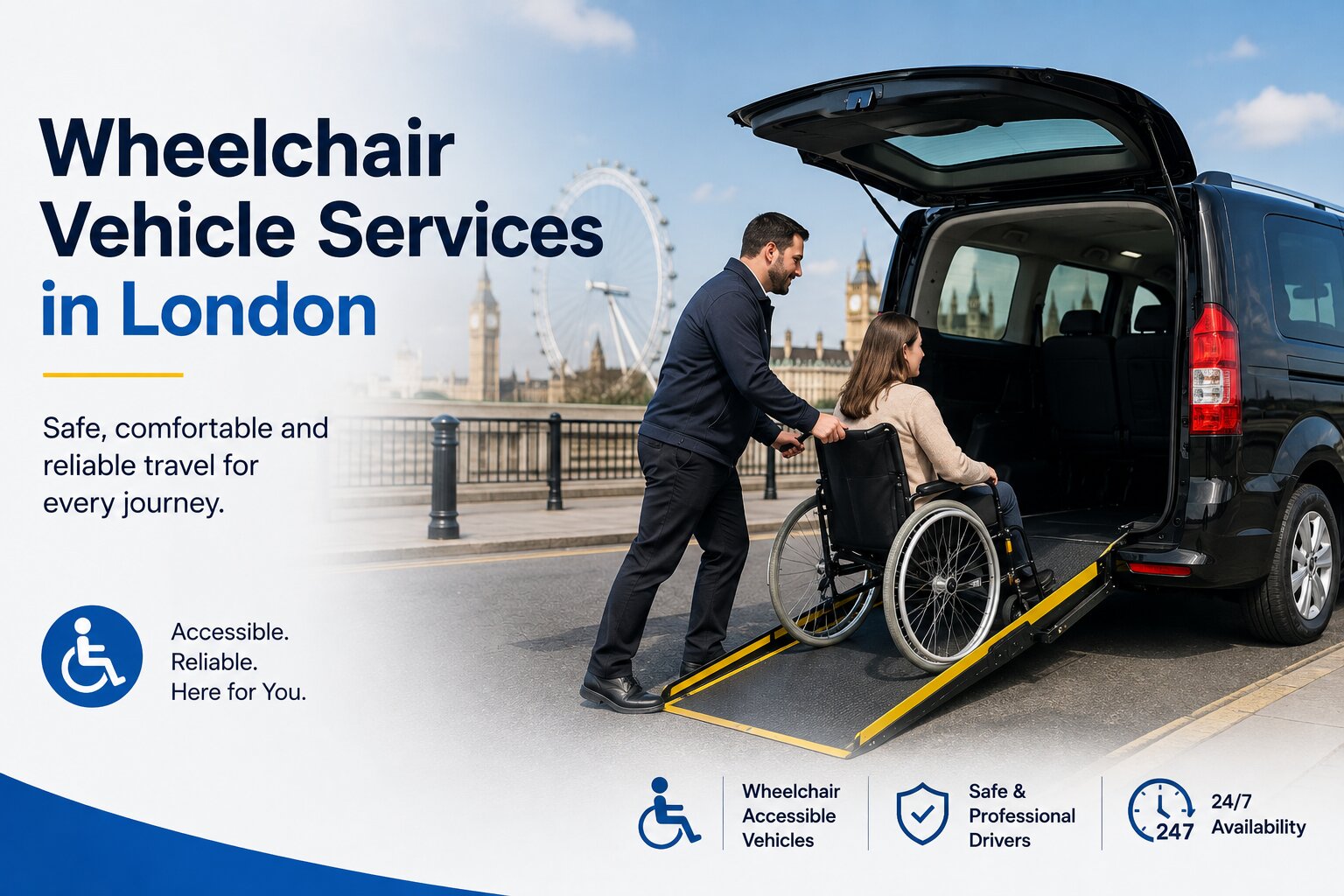
Finding reliable, dignified transport is one of the biggest everyday challenges facing wheelchair users, elderly passengers and anyone with reduced mobility in London. Standard taxis and minicabs are not built to carry a wheelchair safely, which means passengers are often left transferring into a normal seat, folding their wheelchair into a boot, or being turned away altogether. Wheelchair Accessible Vehicles (WAVs) solve this problem by allowing passengers to travel in their own wheelchair, secured safely, from door to door.
This guide covers everything you need to know about wheelchair vehicle services in London: what a WAV actually is, when you might need one, how airport transfers work at each of the capital's major airports, what a good provider should offer, how much the service typically costs, and the safety standards that separate a professional operator from an ordinary minicab with a ramp bolted on.
What Is a Wheelchair Accessible Vehicle?
A Wheelchair Accessible Vehicle, usually shortened to WAV, is a purpose-adapted car, MPV or minibus fitted with a ramp or tail-lift, a lowered floor, and secure restraint points so a passenger can travel while remaining seated in their own wheelchair. Unlike a standard saloon car, a WAV removes the need to transfer between seats, which is often uncomfortable, undignified or simply impossible for many passengers.
A genuine wheelchair accessible taxi in London will typically include the following:
- A manual or powered ramp, or a tail-lift for larger powered wheelchairs
- Four-point restraint straps or a docking system to secure the wheelchair
- A three-point seatbelt adapted for a seated wheelchair passenger
- Sufficient headroom and turning space for powered and manual wheelchairs
- Space for a companion or family member to travel alongside the passenger
Why Accessible Transport Matters in London
London's public transport network has improved its accessibility over the years, but step-free access remains inconsistent across the Underground, and even accessible stations can involve long walks between platforms and lifts. For many disabled and elderly Londoners, a dependable wheelchair taxi service is not a convenience, it is the only realistic way to reach a hospital appointment, an airport, a family event or a place of work on time and without stress.
Demand for accessible private hire has grown steadily alongside London's ageing population and rising awareness of the Equality Act 2010, which requires licensed vehicles to make reasonable adjustments for disabled passengers. A dedicated wheelchair transport service goes further than simply meeting the legal minimum, building the entire journey, from booking to drop-off, around the needs of the passenger.
Types of Journeys That Need Wheelchair Vehicle Services
Airport Transfers
Accessible airport transfers are among the most requested wheelchair taxi journeys in London. Airports involve long distances between the drop-off point, check-in and the gate, heavy luggage, and strict timing around flights, all of which are far easier to manage with a pre-booked wheelchair accessible airport taxi that tracks your flight and adjusts pickup times automatically.
Hospital and Medical Appointment Transport
Medical appointment transport is time-sensitive and often recurring, whether that means dialysis three times a week, physiotherapy, or a one-off hospital procedure. A dependable wheelchair transport provider will understand ward locations, drop-off restrictions at major London hospitals, and the importance of punctuality for time-critical treatment.
Elderly and Care Home Transport
Elderly passenger transport and care home transport calls for patience and a calm, unhurried approach as much as it does the right vehicle. Drivers trained in assisted travel understand how to help a passenger board safely, communicate clearly, and avoid rushing someone who needs a little more time.
Weddings, Events and Business Travel
Wedding wheelchair transport and accessible event transport matter just as much on happy occasions as they do for medical journeys. A wheelchair user should never have to miss out on arriving in comfort and style for a wedding, graduation or business meeting simply because standard executive cars are not built for wheelchair access.
Wheelchair Airport Transfers Across London's Airports
Each of London's main airports presents its own layout and challenges for accessible travel, so it helps to book with a provider that has direct experience at all of them.
Heathrow Wheelchair Taxi Service
Heathrows four terminals are spread across a large site, and drop-off and pickup points for accessible vehicles vary by terminal. A specialist Heathrow wheelchair taxi service will know exactly where to stop for each terminal and how to coordinate with airport assistance teams.
Gatwick Wheelchair Accessible Taxi
Gatwick's North and South Terminals are connected by a shuttle, which can be difficult to navigate with a wheelchair and luggage. A pre-booked accessible transfer avoids this altogether by taking passengers directly to the correct terminal building.
Stansted Wheelchair Transport
Stansted sits further from central London, making a fixed-fare wheelchair transport booking particularly useful for passengers who want cost certainty on a longer journey, especially for early morning or late-night flights.
Luton Wheelchair Taxi
Luton's single terminal makes access relatively straightforward, but reliable Luton wheelchair taxi transport is still essential for passengers travelling to or from areas of London and the Home Counties without easy rail access.
London City Airport Wheelchair Transfer
London City Airport's proximity to Canary Wharf and the City makes it a popular choice for business travellers, and a London City Airport wheelchair transfer is often booked alongside executive-style accessible transport for corporate trips.
How Much Does a Wheelchair Taxi Cost in London?
Pricing for wheelchair accessible taxis in London depends on distance, time of day, and whether the vehicle is booked in advance or hailed on demand. As a general guide, short local journeys within a single borough tend to sit at a similar level to a standard executive minicab fare, while longer journeys, such as an airport transfer from central London to Heathrow or Gatwick, are usually priced as a fixed fare agreed at the time of booking.
A reputable provider will never add a hidden surcharge simply because a passenger needs a ramp or additional boarding time. If a company quotes one price for a standard car and a noticeably higher price purely for the wheelchair accessible version of the same journey, it is worth asking exactly what the difference covers.
How to Book a Wheelchair Accessible Taxi
Booking a wheelchair accessible taxi in London is usually straightforward, and most established providers, including Hopon Cars, allow passengers to book by phone, online, or through a booking app. When booking, it helps to have the following information ready:
- Pickup and drop-off addresses, including any step-free entrance details
- Wheelchair type: manual, powered, or scooter, and its approximate dimensions
- Whether the passenger will remain seated in the wheelchair or transfer to a car seat
- Flight number and terminal, for airport transfers
- Any additional passengers or luggage travelling with the wheelchair user
Pre-booking is strongly recommended for airport transfers, hospital appointments and any journey with a fixed arrival time, since it guarantees that a WAV, rather than a standard vehicle, is allocated in advance.
Common Mistakes to Avoid When Booking Wheelchair Transport
Even experienced passengers can run into avoidable problems when booking accessible transport, usually because a detail was assumed rather than confirmed. Being specific at the time of booking saves confusion, delays and, in the worst cases, a vehicle turning up that cannot actually accommodate the passenger.
- Assuming any minicab can be adapted on the day: a WAV must be booked specifically, since a standard vehicle cannot be converted at short notice
- Not confirming the wheelchair's dimensions and weight, particularly for larger powered wheelchairs and mobility scooters
- Leaving airport transfers unbooked until the day of travel, which risks no accessible vehicles being available during peak periods
- Forgetting to mention step-free access requirements at the pickup or drop-off address, such as a lift being out of service
- Not asking whether the quoted price is fixed, which can lead to unexpected charges on longer or delayed journeys
A quick conversation at the time of booking, covering the wheelchair type, journey timing and any access considerations at either end, is usually enough to avoid all of these issues.
Wheelchair Taxi Versus Standard Adapted Minicab
It's worth understanding the difference between a genuine wheelchair accessible taxi and a standard minicab that simply has room for a folded wheelchair in the boot. The two are not interchangeable, even though both are sometimes marketed loosely as accessible transport.
A standard adapted minicab requires the passenger to transfer out of their wheelchair and into a normal car seat, with the folded wheelchair stored separately. This can work for passengers who are able to transfer independently or with light assistance, but it is unsuitable for anyone who cannot safely move between seats, and it is not appropriate for powered wheelchairs, which are often too heavy or bulky to lift into a boot. A true WAV, by contrast, allows the passenger to remain seated in their own wheelchair for the entire journey, boarding via a ramp or tail-lift and travelling secured in place, which is why it remains the safer and more dignified option for the majority of wheelchair users.
Safety Standards and Passenger Comfort
Safety is the foundation of any credible wheelchair transport service. Vehicles should be regularly serviced and inspected, with restraint systems checked before every journey rather than assumed to be in working order. Drivers should be trained specifically in assisted travel, covering how to operate a ramp or tail-lift safely, how to secure different wheelchair types correctly, and how to communicate clearly with passengers who may have additional needs, such as visual or hearing impairments alongside a mobility requirement.
Licensed London taxi and private hire operators are required to meet Transport for London's accessibility standards, but the best wheelchair transport companies treat this as a starting point rather than a target, building additional driver training and vehicle checks into their day-to-day operations.
Wheelchair Taxi Coverage Across London Boroughs
Reliable wheelchair transport should be available across the whole of Greater London, not just in central postcodes. Established providers cover journeys throughout Westminster, Camden, Kensington and Chelsea in the centre; Croydon and Wembley to the south and north-west; Hounslow and Ealing near Heathrow; and Stratford and Canary Wharf in the east, alongside the wider North, South, East and West London areas.
Choosing Hopon Cars for Accessible Travel in London
Hopon Cars operates a dedicated fleet of wheelchair accessible vehicles across London, built specifically for passengers who need to travel securely in their own wheelchair rather than transferring seats. Every WAV in the fleet is fitted with a rear-entry ramp, four-point wheelchair restraints and adapted seatbelts, and every driver completes accessible-passenger training before taking wheelchair bookings.
For airport journeys, Hopon Cars provides accessible transfers to and from Heathrow, Gatwick, Stansted, Luton and London City Airport, with live flight monitoring so pickup times adjust automatically if a flight is delayed. Fares are fixed and agreed at the time of booking, with no additional surcharge for the wheelchair accessible vehicle itself, and advance booking is available for medical appointments, care home transport, weddings and business travel as well as airport transfers. Passengers can book online or by phone, with 24-hour availability for early flights, late arrivals and time-sensitive medical journeys.
Frequently Asked Questions
What is a wheelchair accessible vehicle?
A wheelchair accessible vehicle, or WAV, is a car, MPV or minibus adapted with a ramp or tail-lift, a lowered floor and secure restraint points, allowing a passenger to travel while remaining seated in their own wheelchair rather than transferring to a standard car seat.
How do I book a wheelchair taxi in London?
Most providers, including Hopon Cars, allow bookings online, by phone or through an app. It's best to book in advance and provide the wheelchair type, pickup and drop-off details, and flight or appointment information so the correct vehicle is allocated.
Are wheelchair taxis available 24/7 in London?
Established wheelchair transport providers typically offer round-the-clock availability, covering early morning flights, late-night arrivals and urgent medical journeys, though it's always worth confirming availability at the time of booking.
How much does a wheelchair taxi cost in London?
Costs vary by distance and time of day. Local journeys are usually comparable to a standard executive minicab fare, while longer trips such as airport transfers are typically quoted as a fixed fare in advance, with no legitimate surcharge for the wheelchair accessible vehicle itself.
Can I pre-book a wheelchair accessible taxi?
Yes, and it's strongly recommended for airport transfers, hospital appointments and any journey with a fixed arrival time, since pre-booking guarantees a properly equipped WAV is reserved in advance rather than requested on the day.
Do wheelchair taxis charge extra?
A reputable provider should not charge extra purely for the wheelchair accessible version of a journey. Fares are generally based on distance and time, and any provider adding a separate access surcharge is worth questioning.
Are wheelchair accessible taxis available at Heathrow?
Yes. Heathrow has four terminals with different drop-off and pickup arrangements, so booking a specialist wheelchair accessible airport taxi in advance ensures the driver knows the correct terminal procedures.
Can wheelchair users travel without transferring?
Yes, that is the core purpose of a WAV. A ramp or tail-lift allows the passenger to board directly in their wheelchair, which is then secured with restraint straps, so there is no need to transfer into a separate seat.
Which taxi companies offer wheelchair vehicles?
A number of licensed private hire operators in London run wheelchair accessible fleets, including Hopon Cars, which operates dedicated WAVs with trained drivers across the capital and to all major airports.
Are wheelchair accessible taxis suitable for electric wheelchairs?
Most WAVs are built to accommodate both manual and powered wheelchairs, though electric wheelchairs and larger scooters can vary significantly in size and weight, so it's best to confirm the exact dimensions when booking.
What features do wheelchair accessible vehicles have?
Typical features include a rear-entry ramp or tail-lift, a lowered floor, four-point wheelchair restraints, adapted seatbelts, and enough interior space for a companion to travel alongside the passenger.
How safe are wheelchair accessible taxis?
When operated by a reputable provider, wheelchair accessible taxis are very safe, with vehicles regularly inspected, restraint systems checked before every journey, and drivers trained specifically in assisted travel and passenger handling.
Final Thoughts
Wheelchair vehicle services in London have moved well beyond a niche accommodation and are now an essential part of the capital's transport landscape, covering everything from routine hospital appointments to airport transfers, weddings and business travel. The difference between an adequate service and a genuinely good one comes down to properly equipped vehicles, trained drivers, fixed and fair pricing, and a provider that treats accessibility as a standard, not an add-on. Booking in advance with a specialist operator such as Hopon Cars removes the uncertainty from accessible travel, so the focus can stay on the appointment, the flight or the occasion, rather than the journey to get there.